Chapter Twenty Four: Chile

Chile started on a low note for us, with the US presidential election. We had bought wine and snacks and made friends with an American couple staying at our ho(s)tel and were excited to watch the results come in. Between the spotty internet and the bad news coming in with each click on the ‘refresh,’ the night ended on a somber note that we were certainly not expecting. The next day was also a bit glum as we couldn’t shake the implications of what had happened. Luckily, we got to feel glum in the picturesque setting of the Atacama desert in the town of San Pedro de Atacama (SPA). The town itself is quite touristic and serves as a jumping off, or finishing, point to a number of local tours, including the one we had just finished. There is a by-law in the city, restricting the use of artificial lighting and electricity so it has a very rugged, natural feel to it. A very rugged desert town, where you can get pizza, sushi and cappuccinos. Yes, we did! The roads are dirt and the red mountains rise along the sides. We had allotted two days of relaxing after our tour so we meandered around and ate some good food and relaxed at our beautiful accommodations with a lovely patio space but very eclectic owner who kept forgetting things that she told us shortly after.

From SPA we took a very picturesque (through the bizarre rock formations known as Moon Valley) but long 27 hour bus ride to the seaside city of Valparaiso. Valparaiso has a gritty but beautiful bohemian appeal to it. Smattered with art on houses, bridges, walls and very colourful buildings, as well as many, many stray-but-friendly dogs, it was a nice treat after the desert. We had some trouble finding our hotel, but when we did, we were able to sit on the patio and look down the hill over the town and the Pacific ocean. The city is also known for its artistic and beautiful ‘ascensores’ (funiculars) that take you up and down the steep hills. Sadly, there was a government-worker strike for much of the time we spent in Chile, so these were not operational. Which just meant slightly more calorie-burning for us as we hiked up the stairs to explore the main hills.

Valparaiso is really a wandering city, best to explore on foot and at leisure. Its sister city, Vina de Mar, is a short bus ride away and much more resort-styled. We spent a day there, walking along the beaches and eating amazing ceviche and salmon. We didn’t find much nightlife, so we got a $4 bottle of wine and settled in for the night.

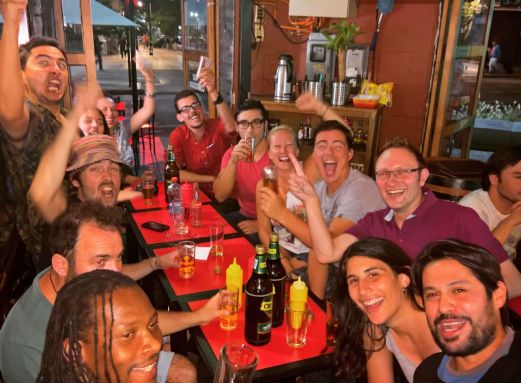
The next day we went on to Santiago, the capital city. We were both really impressed by the modernity of it. It really appears to be a first world city – clean and large with amazing museums, bountiful markets, well kept gardens and terrific infrastructure. We were surprised to hear that there is still a massive income inequality gap here as it appears to be quite affluent throughout. It is, in any case, a great city to spend a few days in. They had an amazing new museum on the Pinochet dictatorship and human rights abuses. We did two different walking tours, both with excellent guides. We joined one of them, along with his friends, after our tour to watch Chile vs. Uruguay in a world cup qualifier game. Luckily, Chile won so the bar was alive and everyone was celebrating with calls of “Chi-Chi-Chi, Le-Le-Le, Viva Chile!”

img-20161211-wa0044

We also had some local dishes: pastel de choclo (like a shepard’s pie but with mashed sweet corn instead of potatoes) and two seafood dishes, one like a mixed seafood in broth and another that was like creamed stew with crab.

(From here we dipped over into Mendoza, Argentina for a few days because we had time to kill before our flight to southern Chile, but I will save that for my Argentina blog.)

We took a short flight to Chilean Patagonia, to the town of Punta Arenas, as it is not really accessible by bus, due to all of the lakes and lake of proper roads. Really just our jumping off point to cross into Argentina, we didn’t find much in the town itself, aside from overpriced food and laundry. We walked along the waterfront and explored the town, but the highlight was probably having food and wine with some new Czech friends that we met at our hostel in the evening. And with that, we were ready to move on from Chile. ❤


Chapter Twenty Three: Bolivia Pt. 2 (Santa Cruz & the Salt Flats)

Getting out of Rurranabeque was not quite as peaceful as arriving. It started with twelve hours of mini-busses across a road that appeared as though it was being made as we drove along. Really just a somewhat flattened strip of dirt with machinery dotted along the shoulders, the debris flew in the windows constantly at Jasper and I in the back seat as the windows were kept perpetually open. At dusk, dirt was replaced with large beetles that landed on and around me. Suffice it to say, it was a relief to get to Trinidad, where we would be boarding an overnight, proper, bus. However, when we arrived, we learned that all busses leaving that night were sold out (of course you can’t book online, don’t be silly!), but we were offered two unofficial “seats” in one of them by the driver, for cash. This turned out to be the nook behind where he sat, which, not only dirty and smelling heavily of body odor, was frigid cold and our bags were stowed in the back already, to which we had no access. We spent the night awake, taking turns blocking the AC vent with our bodies and shivering together.

It was our final penance, I suppose, as we spent the next five days in private-bathroom’d, air-conditioned, Wi-Fi’d bliss. There was even a pool!! Jasper has a friend who is Bolivian and had lived some time in Canada. He and his wife now live in Santa Cruz and they were amazing hosts/tour-guides for us as we took a much-needed week of normalcy in their lovely condo. They had a fantastic meal of local dishes prepared for us for lunch on arrival, and took us for afternoon ‘tea,’ where the tea is replaced by a sweet plum juice and the finger sandwiches are small empanadas and sweet bites. We were also lucky enough to arrive just in time to catch the two soccer (football) teams of Santa Cruz play one another.

Bolivia is considered the poorest country of South America and you can see this quite easily strolling through most cities or town for even a block. Not so in Santa Cruz where there is a concentration of wealthy elite a stones’s throw from the city centre. Fried chicken shops are replaced by Mercedes dealerships and sushi shops are a dime a dozen (we went, of course). However, if you wander a few ‘rings’ (think peripherique) away from the centre, the roads become dirt and the infrastructure disintegrates. The contrast of rich and poor here is striking and was eye-opening for us.

I must say, though, it was nice to have a few days of familiarity. We visited the juice bar business our friends have developed (Be Natural – fantastic product!), went out for burgers and fries and had some lounging days. We also visited the Incan ruins called El Fuerte just outside of the Alpine-inspired town (which I think had more of a Tuscan feel) of Samaipata. After five days, laundry done and feeling fresh, we were ready to hit the road again.

Our destination was Uyuni, where we would begin a tour of the salt flats, but we stopped at the capital city of Sucre for an overnight first (La Paz is the government/de facto capital). This is the nicest Bolivian city I’ve seen, in terms of aesthetic and cleanliness. It also didn’t have the same abject poverty feeling as the others we have been through. It’s known as Cuidad Blanco, ‘the white city,’ as all of the buildings are whitewashed annually by mandate. The result is a picturesque smattering of white houses with red roofs in the rolling hills. We arrived on a day that the president (up for a controversial re-election and Peruvian president were to be visiting. While we did not see the men ourselves, we did see hordes of school children lined up with flags and cheering at all cars and passersby.

Pretty but secluded, a day of wandering was enough for us. We bussed on another ten hours or so and stopped briefly at Potosi, the highest city in the world at an altitude of 4,090 m. Nauseating and bleak, we were happy not to have planned any more time there. We had lunch (fried chicken, one of the few guaranteed finds at any city, village or junction), took a few photos, and continued on to Uyuni.

The town of Uyuni is very clearly maintained solely by the recent tourism of the Salar – the salt flats. Otherwise a ghost town, the central few streets are decorated with nearly identical English-menu restaurants and shops selling alpaca gear. We had our lama steak, bought some gloves and called it a night.

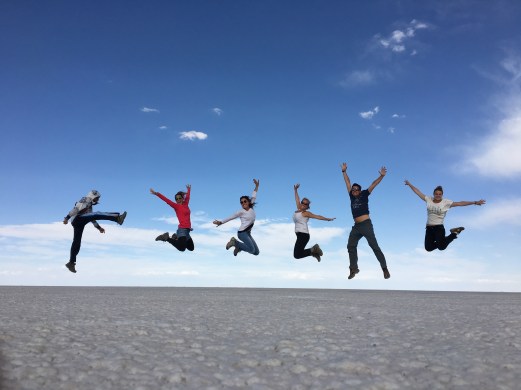
The next morning we grabbed some food at the market and boarded our tour van to see the flats. Our group had six people plus a short and surly guide. The group was great, there were three Spanish-speakers from Spain and Argentina who all met in Dublin, and a quieter German girl traveling on her own. On day one we stopped at a train graveyard nearby and then went on to explore the salt flats, which are vast and incredible. Resembling a pure white desert, you can see for miles in any direction with mountains peaking up at the edges. We stopped at Incahuasi (house of the Incans) which is a cactus island in the middle of the salt dessert and where the Incans had previously settled, believing it was a holy place. Being there, you can certainly understand how they might think this. I made friends with some lamas before heading on to take the oh-so-touristic photos using the distance distortion of the white grounds. When in Rome! We spent the night in a hotel made almost entirely of salt (save the beds). Even the tables and chairs were salt (ironically, the food was a little bland). It was among the most unusual places I have ever slept.


img_4672528

On day two, we left the salt flats and continued on through the desert, reaching an altitude of 5000 meters. I decided to skip the altitude pills this time and felt much better. We drove through reserve nacional de fauna andina Eduardo Avaroa, where we saw lagoons with anywhere from a handful to thousands of flamingos. We saw plenty of lamas and alpacas. We visited the Laguna Colorada which is a large flamingo-filled lake that is a rusty red colour. We stopped for the night at a more modest, but pleasant, hostel where we watched the sunset and then watched the stars from a hot springs basin.

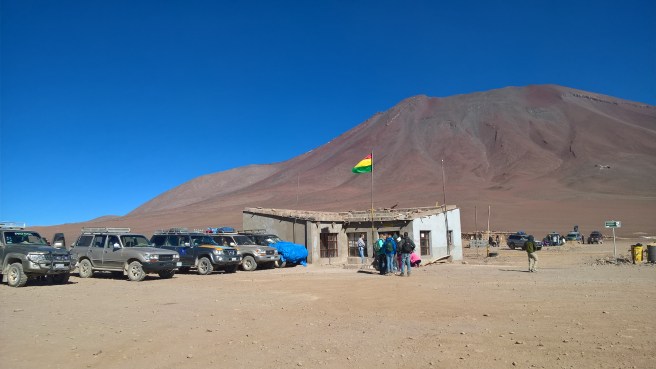
The next morning, we stopped at a lake that is supposed to be emerald green, however, as the wind wasn’t cooperating, it just appeared to be an ordinary lake. We reached the end of the trip the border of Bolivia and Chile, where we had arranged through the tour operators – and paid for- a transfer to San Pedro de Atacama. However, when the shuttle never arrived, our tour guide (did I mention I didn’t like him?) said it wasn’t his problem and was set to leave us there in the desert with no option onward to a town. Money aside, this was a scary and dangerous prospect and I got vocal about it. I don’t think Jasper has ever seen me yell at someone but something snapped and I lost it. Eventually, the “guide” begrudgingly arranged for us to take the last available seats on the last bus out of there for the day. It was a relief but an exhausting morning. I looked at other reviews for this trip online and found that our experience was, in fact, far from the worst. Many people mentioned that their drivers were not only rude but also drunk and some were even physically abusive.

wp_20161108_09_30_36_pro

Bolivia – you are incredibly beautiful but you need to step up your tourist game in a big way. It’s a wonder that so many people still come through. We certainly got the impression that it is assumed tourists would come regardless, so they can both charge whatever they like and have no obligation to be friendly or helpful. And there is also the assumption that tourists have endless resources to spend on travel. Needless to say, our salt flats guide did not get a tip!

One way or another, we had made it through Bolivia and were excited to start our Chilean adventure. ❤


Chapter Twenty Two: Bolivia Pt. 1 (La Paz & Rafting the Rainforest)

Getting around in South America is not as easy, or inexpensive, as you might think. The continental flight game over here has nothing compared to Europe’s answer of Ryan Air and Easy Jet. From Cartagena, we flew to Bogota, then Santiago (to where we will soon return), then La Paz. It was a long overnight journey, spent mostly in cold and uncomfortable airports when we arrived, at last, in La Paz.

At an altitude of over 3500m above sea level, the atmosphere took some getting used to. La Paz is also essentially a basin where the buildings rise up the mountains surrounding it, until you reach El Alta. Our hotel was on one of these steep hills, so something as easy as going to the minimart and back would leave us completely winded. We took the altitude pills that I brought, but soon noticed that our feet and hands had strong and sporadic bouts of pins and needles. I also felt completely wiped – a fact that I cannot be sure whether to attribute to the altitude or the pills. Needless to say, this took away from our enjoyment of the city a bit. I should say, though, that I don’t think we would have been enamored with La Paz in any case. It felt a bit cold and seemed to lack some focus as a city. We explored, but sadly, on our full day in town, all the museums were randomly closed because a select group of administrators had chosen to celebrate the day as a pseudo-independence day, though the rest of the country had chosen a later date. What we did enjoy were the traditional outfits of the aboriginal peoples, which were quite typical of the andes. That, and the $3 lunches of rice and minced beef with egg.

We made the best of it and took a half-day trip out of the city to the other-worldly urban park aptly named Valle de la Luna (Moon Valley). If you can ignore the village just beyond it, the white stalagmite terrain would indeed be something you could imagine seeing on the moon.(This is also where we discovered saltenas – like an empanada but more of a biscuit texture with a stew of either chicken or beef, with eggs and veggies inside. Hard to eat without spilling, but worth the effort!)

La Paz also served as a jumping off point for a six day Amazon jungle rafting tour that we had arranged. The first day was just transport to the amazon basin town of Guanay, from where we would depart on day two. Another couple from Spain and France had also booked and so the four of us, plus our scrappy and rugged guide, Ruban, to whom hygiene was an afterthought, would be traveling for five days along the rivers Kaka and Beni, on a homemade raft, until we reached the jungle town of Rurranabeque. When I say raft, I mean it in the most primitive sense. We all huddled on four square meters of branches and rubber tires. When we first saw what we would be taking, I think we all wondered why on earth we had decided to pay actual money to spend five days on something that Tom Hanks had built on Castaway. But we did. And the days were hot. Very hot. We purchased and wore sombreros to cover as much of ourselves as we could, and wore long shirts, socks and pants as we baked in the Amazonian heat. We swam in the brown water when we could to cool down, we ate fish that we caught and fruit that we picked. We camped in smelly little tents and wore mosquito netting from dusk until dawn to ward off the insanely adamant sand flies more than the mosquitos, none of whom seemed to mind our 30% deet, in which we cloaked ourselves.


On day four, we encountered a heavy storm and paddled through the rain until we found a vacant hut used by aboriginals to collect fruit. We made a fire, put on semi-dry clothes and slept on a bamboo table with mosquito nets around us while the thunder and lightning crashed on around us. In the morning, we were happy to see that a) the rain had stopped and b) the hut was still in one piece. Damp, dirty and tired, we were happy that this would be the day that we arrived in civilization. We floated into Rurranabeque in the early afternoon, desperate to shower and eat a meal prepared with clean hands. We were also happy to find that the hotel we had booked had – luxury of luxuries – a pool!

Once we cleaned off, the four of us met down there and shared some beers and reflected on the trip. Trying as it could be, we did have amazing moments with serene views of the rainforest, floating peacefully down the river. When the sun was behind a cloud, we could relax and appreciate the beauty of the amazon, the toucans flying above, the capybaras on the shore, the vastness of the wilderness. I would say that this trip was once in a lifetime… in both the sense that I never need to do it again but also in that it was an amazing opportunity to experience the rainforest in a unique way and I’m very thankful that we chose to do this. ❤